Modernizing a Delphi Desktop Application as Key Developers Approached Retirement
-
Industry
Industrial software
-
Project type
Software modernization
Softacom in Numbers
forms were redesigned and updated
customization profiles fixed
was the app Delphi version
Description
Softacom was approached by a German-based company developing an application used to manage and control multiple external devices via the MQTT protocol.
Key developers who had deep knowledge of the system were approaching retirement. And the company did not have enough in-house resources to safely evolve the product on its own. Also, over the years of development, the system accumulated technical and UI debt. It started to affect usability and maintainability.
The client wanted to modernize the application and strengthen the development team.
Softacom joined to help update the UI and refactor critical modules.
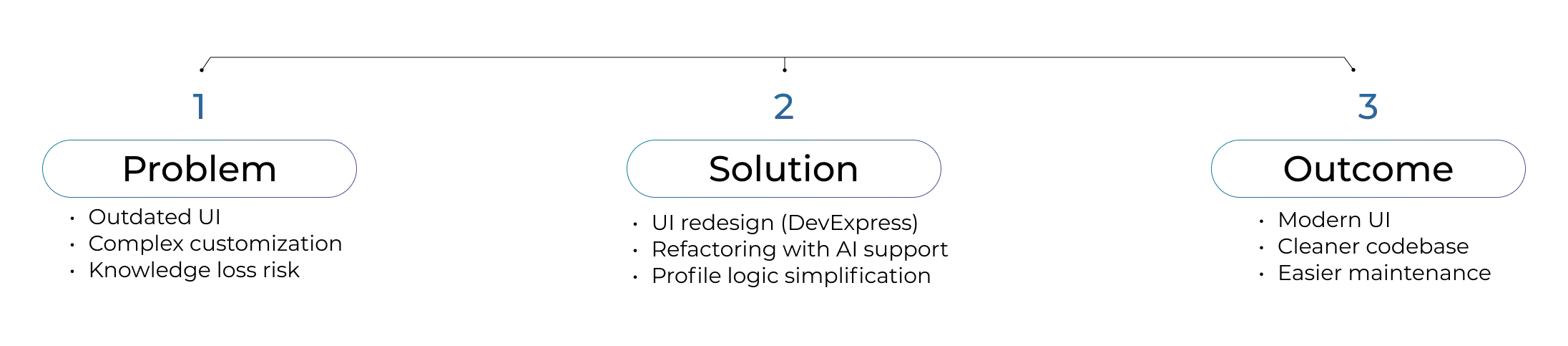
- Outdated UI. The application’s visual layer didn’t meet modern UX expectations. The design looked obsolete, and the UI behavior was inconsistent. The overall appearance negatively affected the perception of the product.
- Complex customization logic. Customization was profile-based, and it had grown too complicated. Manual profile selection and loading increased operational overhead. The system had unused workflow stages remaining. Maintaining customization logic became time-consuming.
- Limited internal resources. The client lacked in-house developers, and key engineers were nearing retirement.
Project Team
- Project Manager/Tech Lead
- 2 Senior Delphi Developers

Solutions
Softacom started by taking ownership of the app’s visual layer. The existing UI relied on legacy components that limited usability and further development. The existing UI relied on legacy components that limited usability and further development. Our team replaced those visual elements with modern DevExpress components. We updated the UI form by form so that the application remained stable during the process. In total, we redesigned more than 50 screen forms.
After we introduced new components, it became clear that a simple replacement was not enough. Many parts of the codebase were tightly coupled to the behavior of the old UI elements. Softacom refactored the surrounding modules in parallel. We adapted event handling and interaction logic to match the new component model. This allowed us to reduce the number of hidden dependencies and improve code clarity. To speed up the work, Softacom team used their proprietary AI-assisted tool for code refactoring.
At the same time, team identified another issue in the customization logic. The application relied on profile-based configuration that accumulated manual steps and undocumented dependencies. This made even small changes risky. Softacom redesigned this logic so that profile selection and loading became automatic. We removed redundant workflow stages and reviewed and fixed 2000+ customization profiles. That simplified working with profiles for users and maintainers.
Outcomes
- The application now has a fully modernized UI with a professional look.
- We redesigned and updated 50+ screen forms.
- Softacom reviewed and fixed 2000+ customization profiles. We simplified and optimized their logic.
- Our efforts led to reduced maintenance complexity and a cleaner codebase.
The system is now better prepared for future changes.