Moving an Older Delphi Product to a Cloud-Ready Architecture Without a Rewrite
-
Industry
Operations Management Software
-
Project type
Software Modernization
Softacom in Numbers
lines of code
users
service organizations supported
business workflows analyzed
Description
Softacom was contacted by a US-based software product company that provides operational management software for service organizations across multiple states.
The platform was developed over more than 15 years using Delphi XE7, PostgreSQL, and a collection of third-party components. It consisted of more than 528K lines of code, supporting 2,500+ users across 120 service organizations in multiple US states.
The desktop application was deeply embedded in customers’ daily operations. It handled multiple processes, including scheduling, resource allocation, field activities, reporting, customer records, and billing workflows.
The business faced increasing pressure from both existing and prospective customers:
- Customers expected browser-based access
- Enterprise buyers requested hosted and SaaS deployment options
- Remote and distributed teams wanted access without desktop installation
- Competitors were positioning cloud-first products more aggressively
Management understood that the product needed to evolve, but a complete rewrite presented significant business risk. Since the platform was developed a long time ago, it contained thousands of business rules accumulated, many of which were poorly documented but essential for customers’ daily operations.
The company needed a path toward a modern web-enabled architecture without disrupting the product that generated its revenue.
Business challenges:
- Growing customer demand for browser-based access and hosted deployment models.
- Enterprise buyers increasingly expected SaaS-ready solutions.
- Competitors were strengthening their cloud-first positioning.
- Remote and distributed teams wanted access without desktop installation.
- A full rewrite could disrupt daily operations for more than 2,500 active users and introduce significant business continuity risks.
Technical and architectural challenges:
- More than 15 years of business logic tightly coupled with the desktop UI.
- Limited documentation for critical workflows and operational rules.
- Large Delphi XE7 codebase containing legacy dependencies and custom components.
- Critical business rules hidden inside forms, event handlers, and legacy workflows.
- Database access logic distributed across multiple application layers.
- Risk of introducing regressions through a full rewrite approach.
- Increasing effort required to onboard new developers familiar with the legacy architecture.
- Need to support existing desktop customers while building a future web strategy.
- Concerns that migration decisions were being driven by technology preferences rather than business priorities.
Solutions
Understanding what we can’t lose
Rather than jumping straight into technology choices, the engagement began with a simple question: what exactly needed to be preserved for the business to succeed? The client’s product had evolved for 15+ years. It had accumulated countless operational rules, customer-specific workflows. Much of this knowledge lived inside the application itself, not in documentation, which meant that any Delphi legacy modernization effort had to start with understanding the system before changing it.
Discovery and architecture assessment
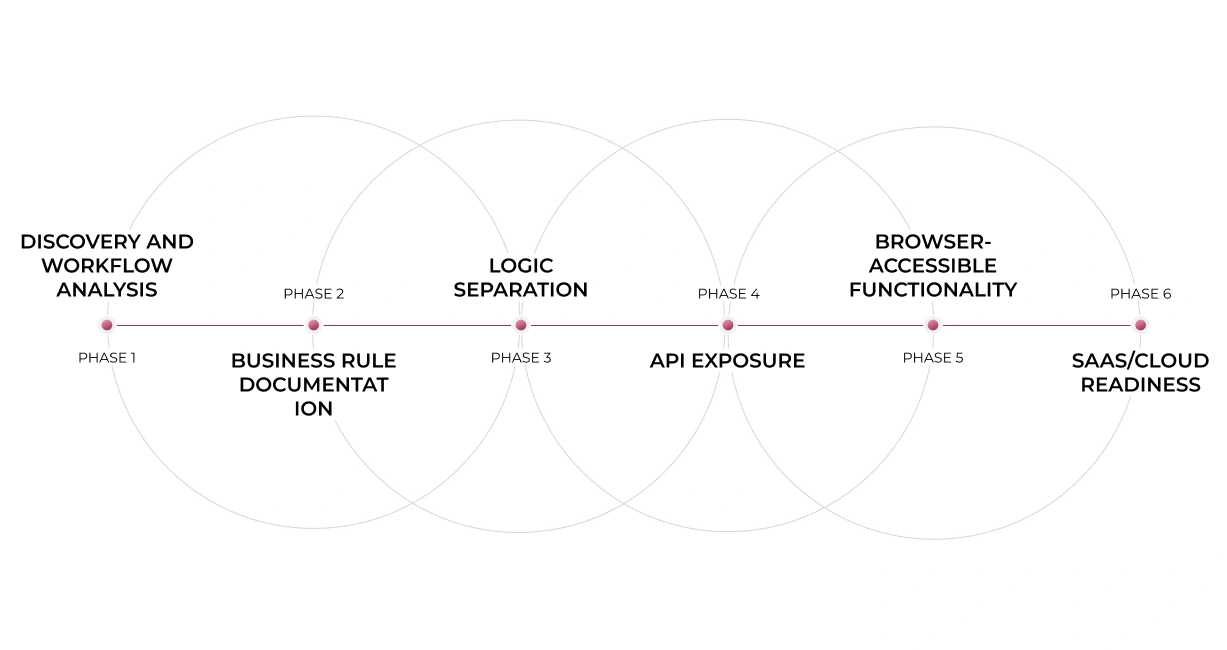
The first phase focused on discovery. Together with the client’s team, Softacom analyzed how the platform was used in real-world scenarios, tracing the flow of data and identifying the workflows customers relied on every day. We analyzed 45+ business workflows, reviewed 70+ desktop forms, and documented over 300 business rules that had accumulated throughout the product’s evolution. This process revealed that the primary challenge was not the Delphi technology stack.
The real issue was that business logic, user interface behavior, and database access had become tightly intertwined over years of development.
As the team dug deeper, it became clear that a rewrite would introduce unnecessary risk. Many critical business rules were hidden inside old forms and event handlers. To recreate them from scratch, the company would need to rediscover years of accumulated operational knowledge. And there was no guarantee that every detail would be captured correctly. Instead of replacing everything at once, the team proposed a gradual architectural transition.
Why a full rewrite was too risky
During the assessment phase, it became clear that a full rewrite would introduce significant business and operational risks.
The platform had evolved over more than 15 years and supported over 2,500 active users across 120 service organizations. Throughout that time, thousands of operational decisions and business rules had been added into the product.
Many of these rules were not documented. They were embedded directly within desktop forms, event handlers, validation routines, and workflow-specific application logic.
Rebuilding the system from scratch would require rediscovering and recreating years of accumulated operational knowledge. Even with detailed planning, there was a substantial risk of overlooking edge cases, unintentionally changing business behavior, or rebuilding functionality that customers already relied on every day.
Rather than replacing a working product, Softacom recommended preserving proven business functionality while gradually evolving the architecture. This approach significantly reduced legacy software modernization risk and allowed the company to continue serving existing customers throughout the transition.
Separating business logic from the desktop application
Our Delphi desktop modernization strategy centered on separating responsibilities within the application. Softacom team identified and isolated business logic from the desktop interface. This is how we created a foundation that could be reused beyond the original client application. We also introduced new service layers and API boundaries around key operational capabilities, allowing functionality that had previously existed only inside desktop screens to become accessible through well-defined interfaces.
This shift allowed the same business processes to be consumed by future web applications without duplicating logic. At the same time, existing desktop users continued working with familiar tools, avoiding disruption to daily operations.
Building an API-first foundation
Once we extracted the core business functionality from the user interface, key capabilities were exposed through reusable service interfaces and APIs.
Functions that had previously been available only through desktop screens became accessible to other applications and future web components. This created a foundation that could support both the existing desktop product and future browser-based solutions while keeping business rules centralized in a single location.
Incremental migration instead of a full rewrite
With this foundation in place, Delphi modernization could proceed incrementally. Rather than attempting to migrate the entire product at once, we focused on areas where web access would deliver the greatest business value. We prioritized customer-facing capabilities, while keeping more complex operational workflows in the desktop environment until the supporting architecture was ready. This allowed the product to continue evolving and generating revenue throughout the transition.
Preparing for SaaS and cloud deployment
As more functionality moved behind service interfaces, the platform naturally became better suited for hosted and cloud-based deployment models. What began as an effort to modernize a legacy desktop application gradually transformed into a roadmap for SaaS readiness.
Importantly, we achieved this outcome not through a wholesale technology replacement, but through a deliberate architectural evolution that protected the company’s existing investment while preparing the product for future growth.
Outcomes
The project delivered a controlled transition path toward a modern architecture while protecting existing revenue-generating functionality.
Results included:
- Business-critical logic was preserved without requiring a high-risk full rewrite.
- We identified and documented more than 300 business rules and operational workflows during the transition.
- 15+ core business functions were exposed through reusable APIs, creating a foundation for future web applications.
- Softacom delivered the first browser-accessible functionality within 4 months of starting the modernization initiative.
- Existing desktop customers experienced no disruption to daily operations during the migration process.
- The phased approach helped avoid an estimated 18–24 month full redevelopment effort associated with a complete rewrite.
- The new architecture enabled a practical path toward hosted and SaaS deployment models without replacing the entire product at once.
- Development teams gained clearer separation between business logic and presentation layers, making future enhancements and onboarding significantly easier.
But we think that the most important outcome was strategic: the company avoided treating modernization as a framework replacement project and instead approached it as an architectural transition. This significantly reduced risk and created a practical path from a legacy desktop product to a cloud-ready future.