With the growing adoption of AI agents for business workflows, many companies face a new challenge. How to use these tools securely AND maintain control over business processes? AI agents for secure internal workflow execution can speed up repetitive tasks and collect data from various systems. But without proper governance, this can lead to risks to processes and compliance.
This article aims to show business leaders how to securely use AI agents for process automation so they deliver real value.
Key Takeaways
- AI agents need governance to be safe in real workflows
- Control is built through data access, permissions, and logging
- Human oversight remains essential
- A controlled PoC helps test behavior, identify risks, and ensure the AI agent fits real business processes before full deployment.
Why is Governance Critical for AI Agents?
Enterprise AI agent solutions differ from traditional automation as they don’t perform predefined actions. They work with context and often take part in processes that were once done by humans.
This is where the main tension arises. When a process is accelerated but without enough control, the company loses transparency. For example, an AI agent can collect data from multiple sources and start an action. But without an audit trail, it becomes unclear where the information came from and why a particular decision was made.
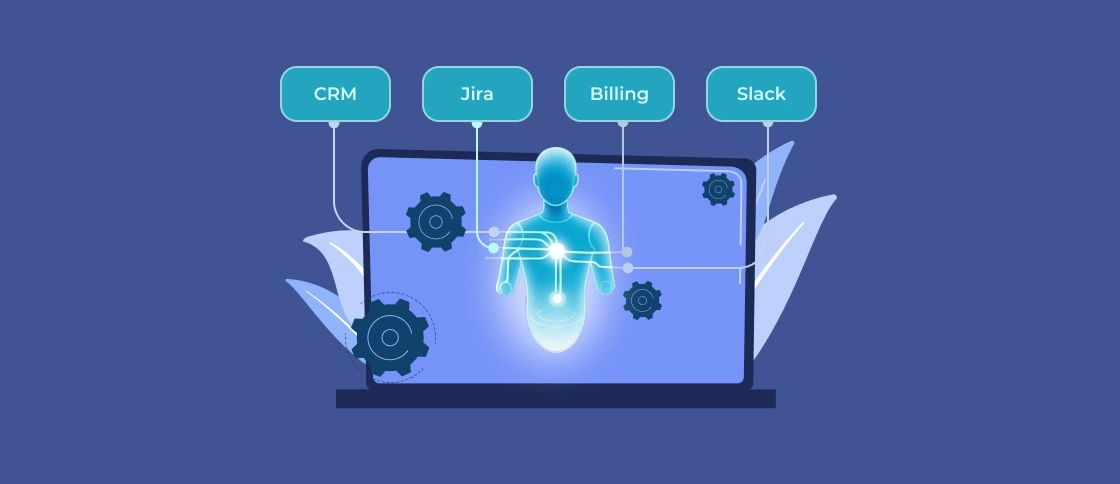
The second problem is data access. Agents often connect to CRM systems, internal databases, documents, and financial systems. If access is unstructured, there is a risk that the agent will use sensitive data.
The third risk area is process execution. Without clear rules and restrictions, an agent may act inconsistently. For example, skip a step, route a task incorrectly, or fail to start an escalation. When work is manual, such failures are usually immediately noticeable. But in automated work, they can accumulate.
Finally, there’s the issue of auditing and compliance. When humans and AI work on a process together, without transparency, it becomes difficult to prove how an operation was performed. And this is critical for many companies.
Key Components of Secure AI Governance
Data governance
AI agents work with information that is often sensitive and distributed across different systems. To maintain control:
- Restrict access to critical data and segment sources.
- Audit all agent actions: what, when, and what data used.
- Create transparent traceability for internal checks and audits.
Example: An agent collects contract data for a compliance report, but only after review by a manager. All actions are recorded in a log and are available for audit.
Access control
Access control ensures that AI agents perform only authorized actions:
- Define roles and access rights for each agent
- Build in a human-in-the-loop for critical decisions
- Restrict agent rights to perform actions in key systems
Example: an agent can automatically create tickets or reports, but a manager approves some data.
Logging and monitoring
Activity logging and continuous monitoring help identify issues early:
- Record all agent actions and integrate them with existing monitoring systems
- Analyze metrics to assess correct operation and identify deviations
- Maintain transparency for internal control and external audit
Example: An AI agent collects evidence for an ISO audit. All actions are recorded and reviewed by the compliance manager.
A Practical Approach to Implementation
In practice, AI agent access control solutions are embedded during design.
It’s usually wise to start with one specific process that already has a clear workload. Next, it’s important to determine where in this process the AI agent can act independently and where a human should take control. This isn’t always obvious. And this is where the difference between a demo solution and one in production often arises.
The next step is to launch a limited PoC. You should test how the agent behaves in a real environment. Check how it processes data, where errors occur and how clear its logic is to the team.
Then, gradually expand its use while maintaining control and transparency.
Common Pitfalls and How to Avoid Them
Here’s common problems that companies face when implementing AI agents:
- Considering an AI agent a “smart script” that can simply be plugged into a process. This misses the point: the agent begins making decisions, but the system isn’t prepared to control them. As a result, errors either go unnoticed or are detected too late.
- Lack of a clear access model. You give the agent too broad of an access to systems because “it’s easier to integrate.” In practice, this creates risks that are difficult to control and even more difficult to explain in an audit.
- The role of logging is also often underestimated. As long as everything works, the lack of an audit trail doesn’t seem like a problem. But as soon as a situation happens, it becomes impossible to quickly reconstruct it.
- Relying on ready-made AI solutions that don’t take into account specific workflows. They can work in isolated scenarios. But they fail when faced with real operational complexity: many systems and non-standard rules.
How Softacom Helps with Secure AI Agent Deployment
Softacom’s AI agent implementation services are built around the following idea. An AI agent should be part of the process, not a separate layer on top of it.
This means that we study your workflows and design a solution around them. We take into account the software systems involved, where control is required, and where automation is possible without risk.
We pay particular attention to ensuring that the AI agent performs actions within defined boundaries. This approach allows AI to be used as a managed tool within the operational environment.
Implementation usually begins with a PoC. Its aim is to test the technical functionality and how the solution fits into the team’s workflow.
Conclusion
AI agents can indeed simplify complex processes and reduce the workload on teams. But without secure AI workflow automation, they can just as easily create new problems.
That is why the question today is how to use AI in a way that maintains process control.
If you have workflows that involve a lot of manual coordination, discuss with us whether an AI agent can be carefully implemented. Sometimes a short conversation is enough to determine whether there is a viable use case.