- Overview: Reverse Engineering EXE Files and Source Code
- Modern Tools for Reverse Engineering Delphi Executable Files
- Legacy Tools for Delphi EXE Decompiling
- IDR (Interactive Delphi Reconstructor)
- IDA Pro (Interactive Disassembler)
- Ghidra + Delphi Scripts (Including Dhrake)
- Binary Ninja + Delphi Plugins
- Ultimate Delphi Decompiler
- Is Full Recompilation Possible with Delphi Decompiler?
- Legal Considerations of Reverse Engineering Delphi Software
- Challenges with Modern Delphi Versions

Overview: Reverse Engineering EXE Files and Source Code
Delphi EXE decompiler is a software tool designed to reverse engineer Delphi EXE files. They explore the assembly code to rebuild the original source code or a near copy.
Complete decompiling – that is, exactly replicating the original source files – is not feasible. These techniques can offer an insightful analysis of the purpose of a Delphi program.
When the original source code is not known, reverse engineering Delphi can be quite helpful. It can be used for debugging, comprehending proprietary software, or retrieving lost code.
In 2026, Delphi reverse engineering is primarily used for:
- Code and assembly analysis
- Debugging legacy systems
- Recovering lost source code and Visual Studio project assets
- Security research
- Interoperability tasks
Full source code recovery is impossible because of missing symbols and compiler optimizations. But reverse-engineering techniques can bring valuable insights into how a Delphi application works.
Modern Tools for Reverse Engineering Delphi Executable Files
Reverse engineering Delphi executables today requires a combined approach. Older Delphi-specific decompilers are limited to 32-bit exe files built with early Delphi versions. Modern Delphi compilers produce binaries. They require general-purpose disassemblers combined with Delphi-specific scripts and plugins.
Legacy Tools for Delphi EXE Decompiling
The following decompiler tools may work for older Win32 applications. But they are not suitable for modern 64-bit Delphi binaries.
DeDe

DeDe is a Delphi decompiler with an older open-source license. Although not actively updated, it can still be helpful for examining past Delphi projects.
- Limits. Outdated and less efficient with more recent Delphi versions.
- Official source. No official source anymore, but it can be found in archives.
- Instructions. Load the EXE, examine the design, and try to decompile Delphi.
It might not be compatible with increasingly obfuscated code or more recent Delphi versions.
Revendepro

Commercial Delphi executable file decompiler Revendepro specializes in forms and graphic components.
- Limits. Mostly concentrated on UI rebuilding, not on complete code.
- Official source. Revendepro website.
- Instructions. Load the EXE, examine the UI architecture, and create the forms’ source code.
It can replicate the forms, controls, and visual design of a Delphi application with its features.
EMS Source Rescuer
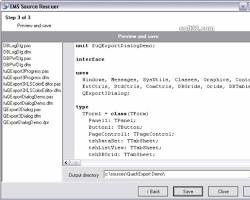
Another commercial decompiler with more powers than Revendepro is EMS Source Rescuer.
- Limits. It may not recover all codes exactly, particularly in highly optimized systems.
- Official source. EMS Source Rescuer website.
- Instructions. Examine the EXE, investigate rebuilt code, and save found bits.
Classes, methods, and data types, among other aspects of the original source code, can be recovered using it.
IDR (Interactive Delphi Reconstructor)

IDR is a strong decoder tailored for Delphi decompiler software. It is designed to extract Delphi-specific structures such as VMTs, forms and class layouts. Primarily from Win32 executables.
- Limits. Not flawless reconstruction; challenges with obfuscation.
- Official source. No official source, but it can be found on various forums or repositories.
- Instructions. Load the Delphi EXE file, examine, and work toward source reconstruction.
You can use this tool for auxiliary analysis of legacy Delphi executables.
IDA Pro (Interactive Disassembler)

Not particular to Delphi, IDA Pro is a strong disassembler.
- Limits. Requires expertise in assembly language.
- Official source. Hex-Rays website (developers of IDA Pro).
- Instructions. Load the EXE into IDA, apply Delphi plugins, and analyze the assembly code.
It can be used with Delphi plugins and scripts to examine assembly code and data structures at a low level, analyzing Delphi executables.
Ghidra + Delphi Scripts (Including Dhrake)

Ghidra is the main free reverse-engineering platform used in 2026. It supports both 32-bit and 64-bit binaries and provides a C-like pseudo-code view.
Delphi-focused scripts such as Dhrake help identify Delphi-specific constructs (VMTs, RTTI, strings). But their effectiveness depends on:
- Architecture (Win32 vs Win64)
- Available metadata
- Compiler version
Ghidra works well with modern Delphi binaries. But Delphi-specific automation is less reliable for 64-bit targets and may require manual analysis.
You can use it for flexible analysis of modern Delphi executables.
Binary Ninja + Delphi Plugins
Binary Ninja is a commercial reverse-engineering platform with a modern UI and scripting support.
Current state:
- Delphi plugins mainly support Win32 binaries
- Limited usefulness for modern 64-bit Delphi applications
Use case: Alternative to IDA for legacy Delphi analysis.
Ultimate Delphi Decompiler
Ultimate Delphi Decompiler is a commercial reverse-engineering utility. It focused on producing a high-level representation of Delphi executables.
Ultimate Delphi Decompiler positions itself as an analysis and recovery tool. It aims to reconstruct logical structures in a form suitable for understanding app behavior.
Strengths:
- User-friendly interface compared to low-level disassemblers
- Focus on higher-level logic
- Useful for exploratory analysis of unknown Delphi binaries
Limits:
- Does not produce original Pascal source code
- Not suitable for modern 64-bit Delphi binaries
- Effectiveness depends on the compiler version and the binary structure
Ultimate Delphi Decompiler is often used as a supporting tool. Developers usually combine it with Dhidra or IDA Pro and x64dbg.
Is Full Recompilation Possible with Delphi Decompiler?
Since there is no concrete answer for Delphi development, it’s better to analyze some basic points:
- Decompiling with Delphi programming services is not always flawless. Especially if the original source code has been extensively encoded or optimized, it could not be feasible to retrieve it exactly.
- There may be some difficult or impossible parts of the code for decomposing. This covers assembly language code as well as those using outside libraries for reverse engineer Delphi.
- Decompiling may take time and cost money. The size and intricacy of the code will determine the time and finances needed.
These restrictions should be known to you if you are thinking of decompiling a Delphi executable. You could also choose to hire a professional Delphi exe decompiler code expertise some thought.
Legal Considerations of Reverse Engineering Delphi Software
Reverse engineering legality depends on jurisdiction, goal and licensing rules. The general principles are:
- Copyright. Decomposing software may violate the rights of the copyright holder.
- Fair use. In some countries, the “fair use” doctrine permits degradation for specific uses. For example, connectivity, error correction, and security research where the copyright holder is not accessible to address problems or find software flaws.
- Licensing agreements. Many software licenses expressly ban decompilation, therefore violating a contractual agreement.
See legal advice to learn the particular rules and regulations in your area. Evaluate the possible legal hazards before dissecting someone else’s app. Respect the conditions of any licensing agreements always. And if at all possible, get the permission of the copyright owners.
Legal Risks
Legal action, including lawsuits for copyright infringement and breach of contract, might follow from decompilation without a good reason and without express authorization from the copyright owners.
Ethical Use Cases
Reverse engineering is commonly considered acceptable when used for:
- Analyzing your own software
- Recovering lost or abandoned code
- Security research and vulnerability analysis
- Understanding undocumented legacy systems for migration
When in doubt, legal advice should be obtained before proceeding.
Challenges with Modern Delphi Versions
Modern Delphi compilers introduce additional obstacles:
- 64-bit architecture
- Aggressive compiler optimization
- Inlined methods and removed metadata
- Limited public documentation of internal structures
Recommended approach:
- Static analysis with Ghidra or IDA Pro
- Dynamic analysis using tools like x64dbg or Cheat Engine
- Manual validation of recovered logic