
Developers face many challenges. For example, they need to keep up with changing frameworks and new major versions. They should ensure scalability across various platforms. Businesses struggle to deliver modern applications without compatibility or security issues.
.NET simplifies development. It gives developers tools to build reliable enterprise applications across various industries. Its influence continues to grow, securing its position in the .NET future. Developers all over the world contribute to its new features and performance improvements.
This article explores the future of .NET. It shows why the framework remains in high demand and how .NET 10 features set standards for software development.
The Future of .NET: From .NET 9 to .NET 10 LTS
In November 2024, Microsoft released .NET 9. Among the significant improvements of .NET Aspire 9 were more efficient algorithms. They have enhanced garbage collection, expanded AI integration, and cryptography features.
The more significant milestone followed a year later. On November 11, 2025, Microsoft released .NET 10, an LTS version supported until 2028. This .NET 10 release delivers performance improvements through runtime and JIT enhancements. These changes reduce startup time, memory usage and CPU overhead. This is quite important for large-scale applications.
.NET also brings in stronger support for AI. It has improved .NET AI integration through Microsoft Agent Framework and Microsoft.Extensions.AI.
.NET in Numbers and Industry Adoption
As of 2024, .NET remains one of the most used libraries and frameworks among developers worldwide, according to Statista.
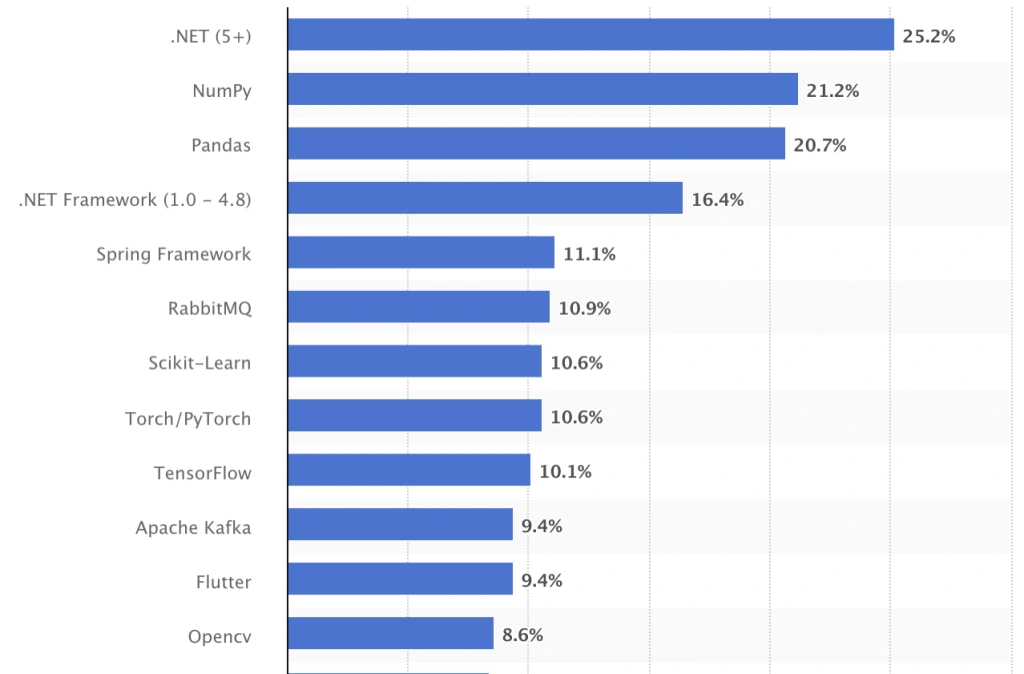
As seen from the chart, 25.2% of software developers use the .NET (5+) framework. Around 7-8 million developers use it worldwide.
.NET supports over 60 programming languages for desktop and web application development. Furthermore, around 34.2% of all websites and web apps run on the .NET framework.
One of the key highlights is its performance growth. Some developers reported a 10-15% reduction in CPU usage when upgrading from .NET 5 to .NET 6. This emphasizes .NET’s efficiency and resource optimization.
The .NET community is vast. Many leading enterprises use it in their technology stack. For example, Tencent, Stack Overflow, Siemens Healthineersm, and others.
To sum up, .NET’s position in the development ecosystem is strong. Its performance improves over time.
.NET Trends That Shape the Future of Software Development
By 2026, .NET trends have moved beyond experimentation. The focus shifted to stable patterns that support scalability and improved performance. Teams prioritize practical implementations that align with cloud-native operating models.
Let’s observe the key trends driving its growth.
Cloud-Native Development and .NET Microservices
More applications today are built with the cloud in mind from the start. .NET supports this shift with frameworks and SDK Microsoft–based tools that simplify integration with Azure services and cloud infrastructure.
Azure SDKs for .NET simplify integration with cloud services. And libraries like Azure.ResourceManager help teams observe API calls and network activity. If the infrastructure runs on Azure, applications can scale when needed and recover from failures.
This matters because most cloud-native applications are built around .NET microservices. Functionality is split into smaller, independently deployable services. .NET supports this with lightweight APIs, background processing and minimal API patterns.
Containers and Kubernetes are now the standard way to run these services. .NET applications integrate with health checks and service discovery out of the box. This helps keep systems stable in production.
Cloud-native applications also use resources only when needed. This helps reduce infrastructure costs compared to traditional monolithic systems. With simpler SDKs and local debugging tools, developers can move faster. They spend more time on application logic instead of managing infrastructure.
ASP.NET Core 10 and Minimal API Endpoints
ASP.NET Core is a key part of modern web development in the .NET ecosystem. ASP.NET Core 10 continues to build on the capabilities of ASP.NET Core 9. For example, built-in OpenAPI support simplifies API documentation and speeds up development.
Another important feature is the HybridCache API for advanced caching. It helps applications retrieve data and keep consistency across instances. This is especially useful for distributed systems and minimal API endpoints.
ASP.NET Core stays cross-platform, running on Windows, macOS, and Linux. Its modular design lets developers include only what they need. This makes ASP.NET Core a practical choice for building scalable web applications.
The Shift from Xamarin to .NET MAUI 10
In May 2024, Microsoft ended Xamarin support. The company moved cross-platform development forward with .NET MAUI 10.
.NET MAUI provides a modern and flexible platform for building cross-platform applications. With .NET 10, MAUI remains fully supported. It offers a stable path for teams planning .NET 10 migration.
Ongoing improvements in .NET 10 continue to strengthen MAUI’s reliability.
Strengthening Application Security in .NET
Security is a top priority in .NET development. Many applications work with sensitive data and run in environments where security risks are real. Recent .NET updates help address common threats such as DoS and RCE attacks. Improved mechanisms make sure incoming data is validated before it can cause harm.
Another key improvement is error handling. It reduces the risk of data exposure during failures or attacks.
By 2026, security in .NET applications follows DevSecOps practices. The security checks are integrated into CI/CD pipelines. Automated vulnerability scanning and dependency analysis help identify risks earlier.
Modern .NET applications also align with Zero Trust principles and post-quantum cryptography support. This helps teams prepare for long-term data protection.
.NET AI Integration
ML and AI are changing how developers solve problems in .NET applications. ML.NET lets teams build machine learning features directly in C# or F#. And it fits naturally into web apps, desktop software, and APIs.
To go beyond basic ML scenarios, many teams rely on Azure AI services. These services add capabilities like predictive analytics and natural language processing.
With .NET 10, AI integration moves further toward agent-based approaches. New libraries make it easier to build AI agents that can coordinate tasks and interact with systems.
Blazor Web Apps in .NET 10
Blazor gives .NET developers a way to build Blazor web apps using C#, HTML, and CSS. And no need to rely on traditional JavaScript frameworks. For teams already working in .NET, this makes Blazor a natural choice.
Blazor also offers a unified development experience. So developers don’t have to switch between different frameworks. It integrates with Entity Framework Core and ASP.NET Core APIs. And reusable components with shared code help teams deliver features faster.
Under Blazor .NET 10, the framework continues to evolve with better WebAssembly performance and tooling.
.NET and Microservices Architecture
In 2026, microservices in .NET are no longer a new or experimental idea. They are a well-understood way to structure applications. Because .NET offers support for building services with clear boundaries and lightweight APIs.
In the cloud, these services are usually run on managed platforms. For example, Azure Kubernetes Service (AKS) or Azure Container Apps. These platforms take care of scaling, traffic management, and orchestration. This reduces day-to-day operational work. .NET services run in containers and are easy to observe in production. This helps teams keep business-critical systems stable over time.
Developer Experience and Visual Studio 2026
The release of Visual Studio 2026 further improves the developer experience. The IDE brings in first class support for the latest .NET runtime and updated project templates.
Visual Studio 2026 focuses more on developer productivity. It uses AI-assisted tools and faster feedback during development and debugging. These changes make it easier to work with large codebases and cloud-native systems. Code quality and consistency are easier to maintain.
Modern C# 14 Features: Extension Members and Language Updates
C# 14 introduces language enhancements aimed at improving readability, safety, and developer productivity. New extension members, partial constructors, partial events and null conditional assignment reduce boilerplate code.
These updates help in large codebases, where clear and maintainable code matters most. Together, C# 14 features helps developers write cleaner code that follows modern .NET design patterns.
Upcoming Releases and Outlook
.NET 10 was released in November 2025 and comes with long-term support. That means Microsoft will maintain it for about three years, through 2028. For many businesses, this makes .NET 10 a practical choice. Stability and predictable support matter more than chasing the newest features.
Its adoption in real products also says a lot. For example, Esri has confirmed that the Q2 2026 release of ArcGIS Pro will be built on .NET 10. Such decisions usually reflect confidence in the platform’s performance and long-term reliability.
Looking ahead, the .NET roadmap stays focused on steady evolution. Upcoming versions are expected to refine runtime performance and expand AI-related capabilities.
Conclusion
As we look toward the future of .NET in 2026, it’s clear that this framework continues to evolve. It adapts to the changing landscape of technology and developer needs. The release of .NET 10 builds on advances in cloud, AI integration and security. This strengthens .NET’s position as a leading platform for modern application development.