- Key Takeaways
- Why don’t Existing Tools Solve the Problem?
- How does the Сompliance AI Agent Work?
- What does This Look Like at the Architectural Level?
- What Data and Integrations are Needed?
- Human-in-the-Loop is Critical
- What Result does This Give?
- How does This Look in Practice?
- Why is Governance Critical Here?
- Common Pitfalls
- How Softacom Can Help
- Conclusion

Audits are rarely a problem in and of themselves. The problem begins long before: at the moment when you need to collect evidence.
It’s the same for most companies. Data is scattered across ERP, Jira, email, and documents. Some information is stored in systems, some in emails, and some in employees’ heads. When it’s time for an audit, the team has to collect everything manually.
This takes weeks. They need to dig up old emails, find confirmations and reconstruct the chain of events. And even then, there’s no certainty that your team collected everything. There’s always the risk that something was missed or misinterpreted.
This is a problem with the process itself not capturing evidence as it executes. They should consider workflow automation AI agents.
Key Takeaways
- AI agents collect compliance evidence in real time.
- Continuous audit trails keep companies audit-ready at all times.
- AI integrates with ERP, CRM, Jira, and document systems to capture and link workflow events.
- Events are automatically mapped to ISO and internal requirements, creating structured evidence.
- Human-in-the-loop ensures governance and control.
Why don’t Existing Tools Solve the Problem?
Most systems already contain the necessary data. ERP records transactions, Jira records tasks and changes, and access control systems record user permissions.
But compliance in this form exists separately from processes. The data exists, but it’s not collected into a single audit trail. It needs to be searched for and compared. Even when specialized compliance tools are used, they often function as an add-on. Verification occurs post-factum. First, an action, then an attempt to prove that everything was done correctly.
As a result, a company becomes “audit-ready” only temporarily, for the time before the audit. The rest of the time, there is no transparency.
How does the Сompliance AI Agent Work?
Instead of collecting evidence retroactively, the AI assistant does so during the process.
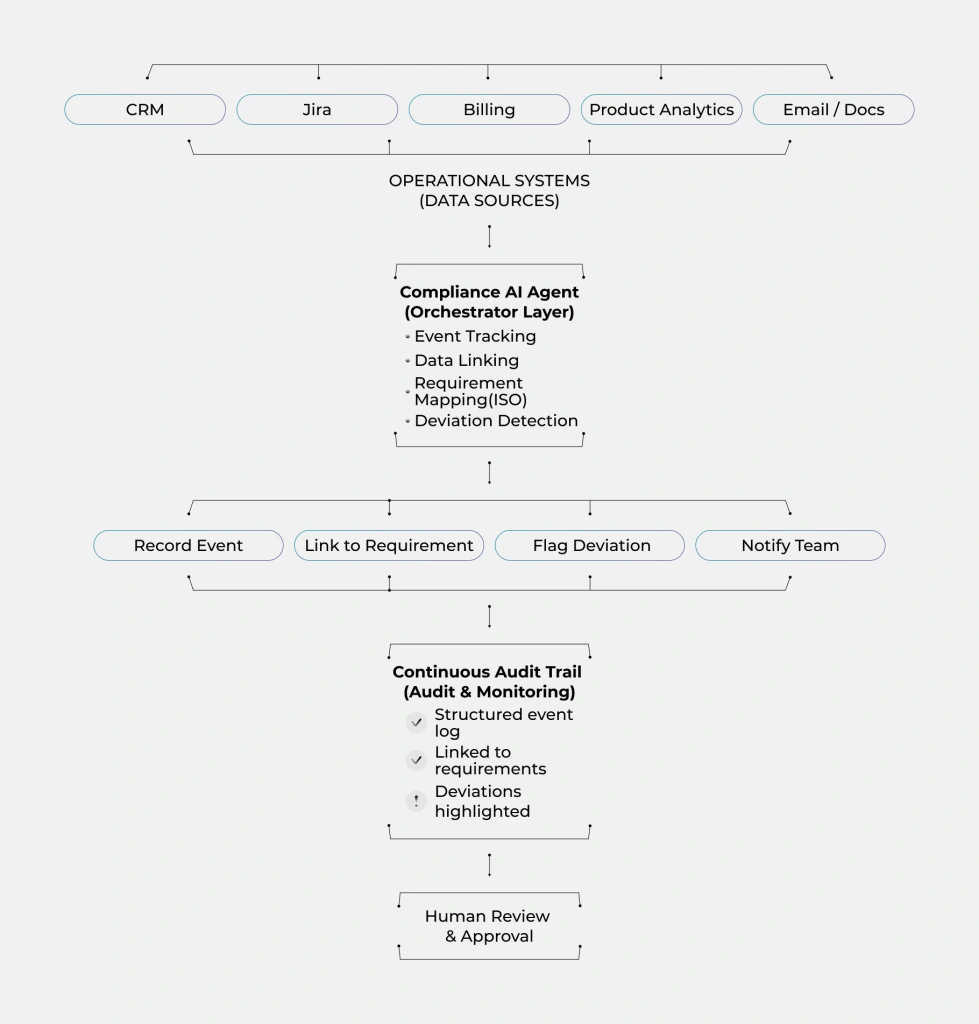
It connects to the systems where real actions occur and tracks events. The events are recorded and compared against specific requirements, whether ISO or other policies. This creates a continuous audit trail. A sequence of real actions linked to requirements. If a deviation occurs in the process, the audit automation software can highlight it.
But such an AI agent doesn’t make decisions for humans. Its job is to record, structure and provide transparency.
What does This Look Like at the Architectural Level?
Technically, this is the layer that connects processes and requirements.
On one side, there are the systems where operations occur: ERP, CRM, task systems, access control, and document management. Events and data arrive from there, via APIs or log and document processing.
These events then pass through the processing layer, where they are cleaned and linked. For example, a user action is linked to a specific task or process. At the center is the agent logic. It determines which requirements the event relates to, whether there is enough data or any deviations.
The result is structured evidence. It is stored along with the full context. All actions are recorded in a log, and at any time, it is possible to reconstruct what happened and why.
What Data and Integrations are Needed?
Automated audit trail solution works where processes already exist. These could be ERP and CRM systems, task management tools, email, document storage, or access control systems. Not only the data itself but also the events themselves play a key role: who did what, when, and with what results. This is what forms the evidence base.
The more closely these sources are linked, the more accurate and complete the audit trail becomes.
Human-in-the-Loop is Critical
Despite compliance process automation, the role of humans is important.
They should stay in charge still. They make decisions in controversial situations and interpret requirements. This is especially important where risks or unusual cases are involved.
An agent removes the routine work of collecting and structuring data, but responsibility and control are on the team.
Logging provides transparency. Any action can be verified and its context understood.
What Result does This Give?
The key change is that compliance is no longer a one-time activity before an audit.
Evidence is collected continuously as the work progresses. Audit preparation no longer becomes a separate project with deadlines and stress.
Teams spend less time manually collecting data. The risk of missing evidence is reduced. Audits are faster and more predictable.
The effect is not immediate, but it is sustainable. As systems are connected and the logic is configured, the process becomes transparent.
How does This Look in Practice?
The company was preparing for regular audits by manually collecting evidence each time. This took up to 3-4 weeks, and some data was still lost or required extra confirmation.
After implementing the compliance AI agent, it recorded events automatically. As a result, the audit trail was formed without any special preparation. The team no longer spent weeks collecting data, and the audits themselves became much smoother.
Why is Governance Critical Here?
Such compliance AI agents work with sensitive data and influence processes. Without control, this can lead to errors or a lack of trust. Roles and transparency are essential. It’s essential to understand what data the agent uses and how it makes conclusions. Logging becomes a foundation for trust.
Common Pitfalls
Compliance is often attempted to be “added” to existing processes rather than built in. Another common scenario is a lack of clear requirements. If it’s unclear what exactly AI agent should record, it won’t be able to accurately correlate events.
Finally, sometimes, companies try to cover everything at once. It’s much more effective to start with one process and gradually expand coverage. And while doing this, maintain control and data quality.
How Softacom Can Help
Softacom’s AI implementation services help embed compliance AI agents so they become part of existing processes. We begin with an analysis of how your current evidence is collected and where gaps arise. We then design an AI agent that connects to systems and records events as they occur. This creates a continuous audit trail.
The solution is first tested in a pilot to see how audit preparation changes and how manual workload is reduced. After this, functionality is gradually expanded. This approach allows to always be ready for audits without changes in workflows.
Conclusion
Compliance shouldn’t begin before an audit. It should happen as the process is being executed.
An AI agent makes this possible by linking data and requirements into a single system.
And this is where the real value lies. It is not an AI compliance automation for the sake of automation. But this brings transparency and control.