- When a Single Business Process Crosses Many Systems
- Key Takeaways
- Why don't Built-in AI Functions Solve This Problem?
- What is an Orchestrator Agent?
- What does the Architecture of Such a Solution Look Like?
- Why is Human-in-the-Loop Important?
- What Benefits do Companies Achieve with Orchestrator Agents?
- How Companies Typically Implement AI Agents
- How Softacom Helps Implement AI Agents

When a Single Business Process Crosses Many Systems
In most software companies, workflows have long since expanded beyond a single system. Sales runs in CRM, development in Jira, finance in the billing system, and daily communications take place in Slack. Each of these platforms serves its own purpose and works quite effectively on its own.
A problem arises when a single business process crosses many systems simultaneously.
For example, launching a new project after a deal is closed. When the sales team records a deal in CRM, the work has only begun. The delivery team then must create a project in Jira. The finance department must add a client to the billing system. The account manager opens a Slack channel for communication on the project.
Each of these actions is simple in itself. But different people do them with different tools and often at different times. They transfer information manually. Some data must be copied between systems. This leads to certain steps being forgotten. As a result, project launches that should take minutes take hours instead. When dozens of such clients arrive per month, processes begin to slow down the entire team’s work.
Key Takeaways
- AI agents can automate workflows across multiple systems such as CRM, Jira, billing, and Slack.
- Orchestrator agents act as an automation layer that connects APIs and business logic.
- Human-in-the-loop controls help maintain security and governance.
- Companies typically start with a small automation pilot before scaling.
Why don’t Built-in AI Functions Solve This Problem?
Many business platforms have been actively implementing AI tools for some time now.
CRM systems automate email generation, help desk systems help categorize tickets, and development tools speed up coding. But almost all of these solutions operate within a single platform.
AI can help a user complete an action faster in CRM or Jira. But it doesn’t manage the process that takes many systems. It won’t automatically create a project in Jira after closing a deal in CRM. It won’t add a client to the billing system or notify the team on Slack.
This is why companies are looking toward AI integration agency expertise. They want to enable AI agent integration that works across multiple platforms. Proper AI agents integration allows your workflow to function as a cohesive process.
What is an Orchestrator Agent?
The Orchestrator Agent is an AI agent that connects many systems into a single workflow. It receives data from various sources, analyzes the context, and executes actions via an API. Unlike a typical chatbot, this agent doesn’t simply answer user questions. Its purpose is to perform real actions within the company’s infrastructure.
Let’s imagine the same scenario of launching a project after closing a deal. When the deal status changes in the CRM, the agent receives a signal and initiates a sequence of actions. It retrieves client and service data, creates a new Jira project, adds the client to the billing system, and opens a Slack channel for the team. Afterwards, it can generate a brief deal summary and send it to project participants. For the team, this is an instant process launch. All workspaces are created automatically. So, employees receive a ready-made context for getting started.
This is where AI agent integration services shine. They make these cross-system workflows operational.
What does the Architecture of Such a Solution Look Like?
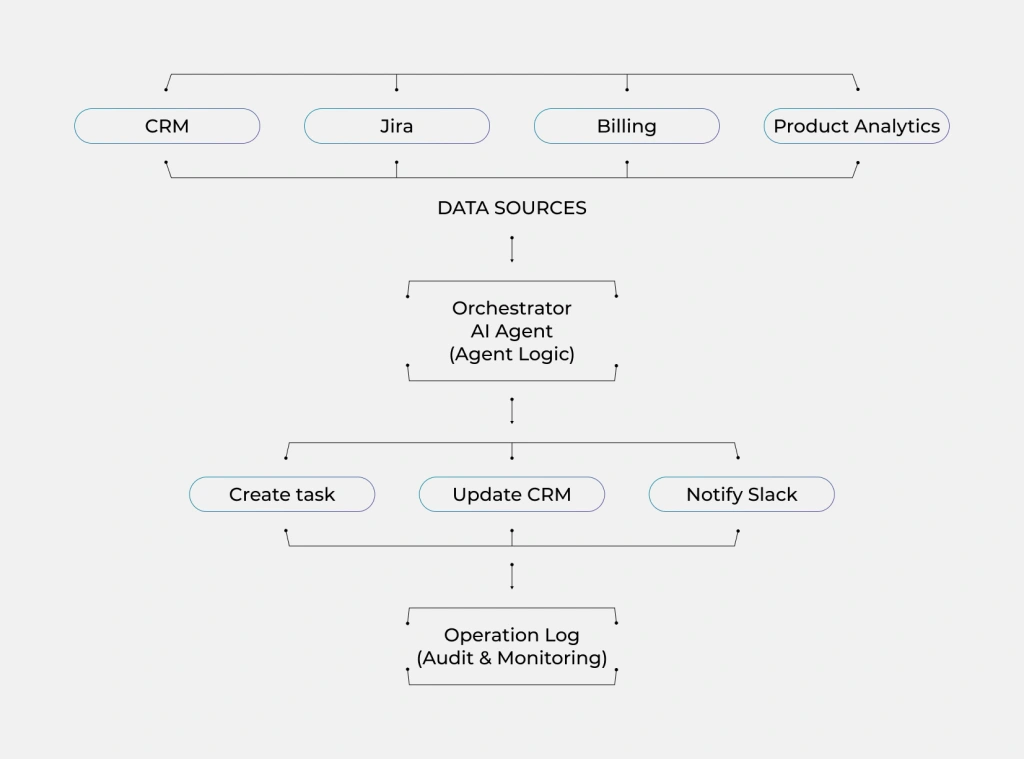
From a technical perspective, the orchestrator agent acts as a connecting layer between systems. It receives data from sources (CRM, Jira, or product analytics) and performs actions in these systems via an API. At the center of this architecture is the agent logic, which makes context-based decisions. It determines which steps should be performed and in what sequence.
All agent actions are recorded in an operation log. This is important not only for diagnostics but also for control. The company can always verify what data was used and what actions the agent performed.
Why is Human-in-the-Loop Important?
Despite the high level of automation, AI agents rarely operate completely autonomously. They require governance mechanisms. Production systems typically use a human-in-the-loop model. It means that humans remain part of the process.
For example, an agent prepares a project structure or creates a customer record. But financial transactions or tariff changes require employee approval. This approach helps mitigate risks and gradually grow the automation as experience increases. Furthermore, systems typically use access control and action logging. This means that AI agents only work with the data and tools they are authorized to use. Every action remains transparent to the team.
What Benefits do Companies Achieve with Orchestrator Agents?
Companies that use agent orchestration for internal processes most often notice two benefits:
- Time savings. Processes that required hours and employee involvement can now be completed automatically in minutes.
- Process quality. When actions are performed according to the same logic, the number of errors is reduced. Automation allows teams to focus on tasks that truly require human intervention. For example, customer service or product development.
Even a small pilot often shows how many operational tasks can be delegated to agents, demonstrating the real ROI of AI agent integration services.
Expected ROI is modest but measurable: for example, reducing operational workload by 30–60% on repetitive workflows and freeing employees to focus on tasks that require judgment or creativity. According to McKinsey, around 45% of the activities individuals are paid to perform can be automated by adapting technologies.
How Companies Typically Implement AI Agents
Most companies begin with a small pilot project rather than full automation. They select a process that involves many systems and requires manual data transfer. In a few weeks, you can design the agent architecture, enable key integrations, and test a workflow.
This pilot helps understand how the agent processes data and what processes are better to automate next. Even a small experiment often demonstrates how many operational tasks you can delegate to agents.
How Softacom Helps Implement AI Agents
Developing production agents requires more than just working with LLM models. Integrations, access management, action logging, and workflow architecture also play a crucial role. Softacom acts as a full-service AI integration agency , delivering services fast and securely.
Softacom has already implemented real AI agents for various companies. We can quickly launch pilots thanks to a ready-made infrastructure and knowledge base. We can also work with local models for secure data processing. Our team understands the advantages and limitations of popular AI tools on the market. Softacom’s engineers can configure integrations with hundreds of data sources to ensure the agent accurately performs tasks within the corporate workflow. This experience allows us to make AI capabilities operational in your company.