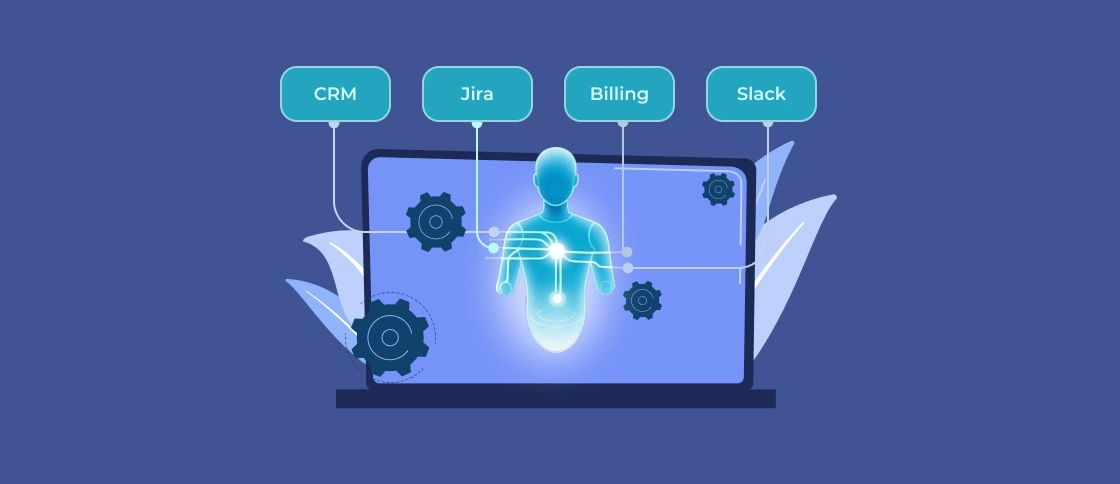
Enterprise AI agents are often marketed today as a quick way to automate workflows. Connect the tool to a CRM, Jira, or Slack, and the agent begins assisting the team: creating tasks, updating data, generating reports.
This looks convincing in a demo. But in real companies, such solutions often begin to fail within a few weeks.
It’s important to understand that this isn’t a problem with the AI technology itself. It’s a problem with the “one-size-fits-all” approach that many off-the-shelf products are built on.
An off-the-shelf agent assumes that companies’ business processes are similar. But in reality, companies with 50–300 employees rarely have simple processes. Presales works with a CRM, delivery manages tasks in Jira, support uses a separate ticketing system, finance checks billing, and communication occurs through Slack and email. Numerous dependencies and rules arise between these systems.
An off-the-shelf agent doesn’t understand these rules. And that’s precisely why it starts to break down.
Below are seven typical reasons why pre-packaged AI agents stop working in a company’s real-world operating environment.
Where ready-made AI agents break down
#1 Ready-made agents do not know the internal rules of the company
Ready-made agents are trained on general knowledge, not your internal playbook. You can give them instructions, but because they aren’t designed with your specific approval matrix in mind, they frequently misinterpret the rules.
For example, in one company, the “client approved” status is simply a comment in the CRM. In another, it requires at least three actions: create a task in Jira, notify the delivery team in Slack and update the deal status in the CRM.
A ready-made agent doesn’t understand this logic. They may receive instructions, but interpret them too broadly or too literally.
As a result, they
- perform the wrong action
- perform it in the wrong system
- skip part of the process
The problem is that the finished product wasn’t built with your workflow in mind.
#2 Ready-made agents do not have a persistent memory architecture
Most ready-made agents were created for short conversations, for example, for customer support. But real business processes rarely fit into a single conversation.
A typical workflow might look like this:
CRM → presales → delivery → billing → report to manager
This process can last several days and involve multiple employees. A ready-made agent can’t maintain process state throughout the entire chain. Therefore, it can “forget” important data.
For example:
- the initial lead score from the CRM
- budget approval information
- a manager’s comment on a previous step
This doesn’t happen because the architecture of the ready-made solution isn’t designed for long-running processes.
#3 Prepared agents work in isolated “silos”
When companies try to solve a problem, they often add another agent. One agent works with the CRM. Another one works with the support system. And a third handles Slack communications.
At first glance, this looks like a scalable architecture. But ready-made agents are usually created by different vendors or using different templates, so they don’t share a common management logic.
As a result, agents don’t exchange critical information. One agent can overwrite another agent’s data. Actions in one system don’t sync with actions in another.
The result isn’t a team of agents, but a collection of independent tools. The problem is that ready-made products don’t have a unified orchestration layer.
#4 Ready-made agents operate as “black boxes”
In ready-made solutions, the user sees only the input and output. You give the agent an instruction and get a result. But you usually have no idea how exactly the agent made its decision. This creates a serious problem.
The agent might claim to understand the task and explain the correct logic, but then perform a different action. Because the decision-making mechanism is hidden, correcting the agent’s behavior becomes difficult.
Often, the only option is to completely redesign the setup or replace the tool.
#5 Ready-made agents might work poorly with data
Most ready-made AI agent solutions assume that data arrives in an ideal format. But in a real company, data is rarely perfect. In a CRM, one manager might write “Enterprise Client,” another one writes “Enterprise,” and a third one puts “Enterprise Lead.”
To a human, these are all the same. To a ready-made agent, these are three different meanings.
As a result, the process can break down due to a slight difference in wording. A ready-made agent can’t account for such variations because its logic isn’t adapted to your data structure.
#6 Ready-made agents perform tasks but do not manage processes
Ready-made agents are good at handling single actions. For example: create a ticket, generate a response, update a record. But many business processes require a sequence of actions and dependencies. For example:
- verify customer data
- confirm billing
- create delivery tasks
- only then send a report to a manager
A ready-made agent doesn’t know this sequence because it’s unique to each company. It performs individual actions but doesn’t manage the entire chain.
#7 The hidden cost of off-the-shelf AI solutions
A license for a ready-made AI agent usually seems affordable. However, after a few months, companies begin to notice additional costs. Costs rise due to:
- a large number of API requests
- manual verification of agent actions
- fixing data errors
- integration with existing systems
Engineering teams spend hours trying to integrate the ready-made tool with CRM, Jira, billing, and legacy systems. As a result, the cost of ownership can be significantly higher than expected.
What Actually Works?
The solution isn’t to wait for a smarter off-the-shelf product. The problem is that off-the-shelf solutions attempt to apply a universal template to unique processes. It’s become clear that the most robust AI agent architecture is tailored to a company’s specific operating environment.
The best performers are: highly specialized AI agents, clear constraints on their actions, human oversight at critical stages, and an architecture that takes into account the company’s actual systems. Such custom AI agents don’t attempt to replace the entire workflow at once. They automate specific steps and gradually expand the automation.
How Softacom Helps Implement Custom AI Agents
At Softacom, we often encounter companies that already have several automation tools in place, but key processes remain manual. These typically involve processes between systems:
CRM → Jira → billing → analytics → Slack → internal documentation
We don’t deploy a generic agent, but the purpose of our AI development services is to create a custom AI agent architecture that takes into account actual workflows. We build agent architecture around your real-world processes.
We begin by analyzing your workflows and processes. Then, we build the agent architecture.
Such an agent can:
- create and update tickets
- record data in CRM
- generate reports
- notify teams
- launch internal processes or pipelines
At the same time, critical operations remain under human control, and all agent actions are recorded in logs.
As a result, the company gains a real automation tool that reduces manual work, speeds up processes, and maintains transparency of all operations.