- Why Standard Tools Don't Solve the Problem
- How does the Procurement AI Agent Work?
- What does This Look Like at the Architectural Level?
- What Data and Integrations are Needed?
- Where does a Person Remain and Why is It Important?
- What Results does This Give in Practice?
- Real-World Case Scenario
- Common Pitfalls
- How Softacom Can Help
- Conclusion

In theory, the procurement process seems simple: collect proposals, compare them and select the best supplier. In practice, things are different. Data is scattered across ERP systems, email, spreadsheets, and contract folders. Communication occurs through multiple channels simultaneously. Terms and conditions change in the middle of correspondence. They are not recorded in the system.
As a result, decisions are made not based on the full picture, but on what’s found most quickly. One manager remembers supplier details, another doesn’t. Someone keeps price lists, others don’t. And the more suppliers and the larger the procurement volume, the higher the cost of error.
This is a lack of connectivity between systems and the decision-making process itself.
Why Standard Tools Don’t Solve the Problem
ERP and procurement systems are good at storing data. But they don’t manage the actual process that occurs between systems. Email and Excel remain the “glue” that holds everything together. This is where final clarifications and agreements are made.
AI tools built into individual platforms operate within a single system. But procurement is always a cross-system process.
Simply put, automation within a single tool doesn’t equal management of the entire procurement process.
How does the Procurement AI Agent Work?
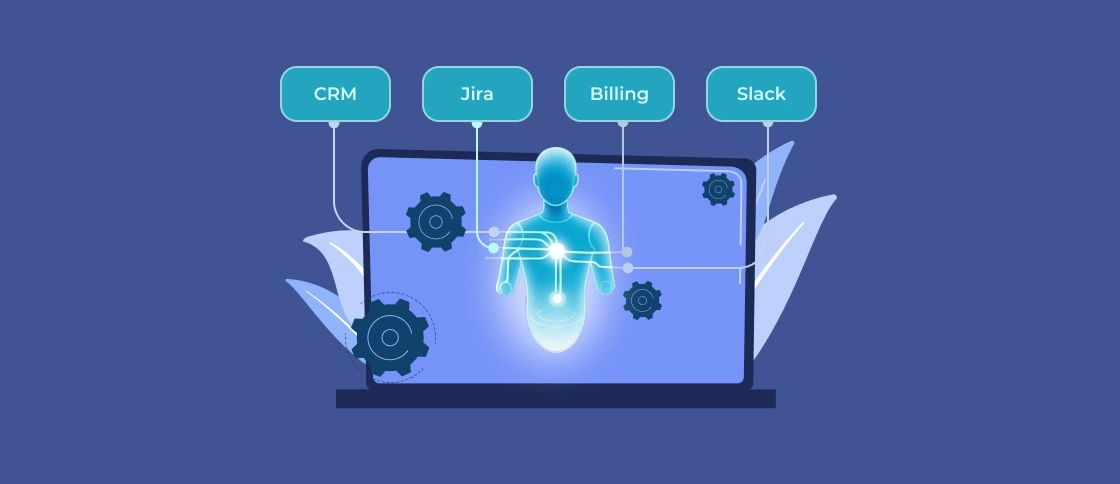
Instead of replacing the system or people, the AI procurement assistant acts as a coordination layer between them. They collect data from various sources: ERP, email, contracts, price lists. They unify it and compare proposals from suppliers. They then assist with analysis. Supplier management AI agents show where prices are higher, where conditions are worse. They can highlight risks, such as sudden price changes or unusual conditions.
Importantly, the agent doesn’t make decisions for the user. They provide context and options. The final choice rests with the purchasing department or the manager.
What does This Look Like at the Architectural Level?
Technically, this isn’t a single system, but a bundle of components. Here are the layers:
- Connected data sources: ERP, CRM, email, contract storage, and supplier databases. Some data comes through an API, while others are parsed from emails and documents.
- The processing layer. The data is cleaned and linked. For example, different price list formats are brought into a unified structure.
- The procurement AI agent logic. It analyzes the context, compares offers, identifies deviations, and generates recommendations.
- The agent performs actions. It updates data in the system and prepares a summary for decision-making.
Each step is recorded in a log. This is important for control. It’s always possible to understand what data was used and why a particular solution was proposed.
What Data and Integrations are Needed?
A procurement automation software’s value depends on the data they work with. Typically, these include:
- an ERP or procurement system, where orders and basic data are stored;
- corporate email, where primary communication with suppliers takes place;
- contract and document repositories;
- supplier databases or external portals;
- historical data on purchases, prices, and SLAs.
The more closely these sources are connected, the more accurate the agent’s recommendations.
Where does a Person Remain and Why is It Important?
Procurement is a responsibility, and it can’t and shouldn’t be fully automated. Humans are always present at key points. They approve suppliers, negotiate terms, and make decisions in non-standard situations. This is especially important for large or risky purchases, where the cost of error is high.
The AI agent for procurement workflow takes on routine tasks, such as data collection, comparison, context preparation.
Access rules and logging are also implemented. This allows for monitoring what data the agent uses and what actions it performs. At any time, it’s possible to check what happened and why.
What Results does This Give in Practice?
The main effect is a clean slate. Teams spend less time manually collecting and reconciling data. Supplier comparisons become faster and more transparent. Decisions are made based on the full picture. Errors related to lost information or misinterpreted terms are reduced.
This typically results in significant time savings on operational tasks and accelerates the procurement cycle. But don’t expect too much. The effect emerges gradually, as data is connected and the logic is configured.
Real-World Case Scenario
In one project, the company worked with dozens of suppliers, and proposals arrived in various formats. Comparisons took a significant amount of time, and some terms were simply lost in the back and forth.
The vendor management AI solution was to implement an agent that collects proposals from emails, normalizes the data, and creates a single comparison based on key parameters. That helped the team make decisions faster. And the process became more transparent, regardless of who was leading the procurement.
Common Pitfalls
The main mistake is trying to automate a process without understanding the data. If sources are disparate or incomplete, the agent won’t be able to produce high-quality results.
The second is the lack of clear rules. Without them, it’s difficult to determine what makes up a “good” or “bad” proposal.
And the third is the desire to automate everything at once. It’s much more effective to start with one scenario and gradually expand.
How Softacom Can Help
Softacom builds a procurement AI agents that work as part of the procurement process. We study your current workflow, design an agent and launch a pilot PoC in a real environment. After a successful test, we gradually expand functionality while maintaining control. This approach allows you to quickly see the agent’s value without risks or disruptions to the existing process.
Conclusion
Procurement problems are rarely related to a lack of tools. Usually, it’s even more so because there are too many of them.
The problem is that they are not interconnected. Decisions are made outside of the systems. An AI agent in this context is a layer that connects data and simplifies analysis. And that’s where real value comes in.