Why Many AI-Agent Initiatives Start with the Wrong Processes
When companies explore AI agents for internal operations, the focus almost immediately shifts to technology. Teams discuss models, integrations, orchestration, copilots, and autonomous workflows. But the success of such initiatives is usually determined much earlier: when they select the first process to automate.
Because the main problem with most internal workflows today is accumulated operational drag.
In many companies, employees perform dozens of seemingly simple tasks daily. They coordinate approvals, transfer tasks between departments, gather context from different systems, clarify statuses, follow up, find process owners, and check dependencies. Formally, the processes work. But they spend a significant amount of time not on the work itself, but on coordinating around it.
These kinds of workflows are often good candidates for AI agents.
However, companies often start cross-system workflow automation in the wrong place. They try to create something as “innovative” as possible. For example, an AI assistant for strategic decisions or an intelligent analytics layer. But in operational environments, the main bottleneck is usually much more prosaic. It is a fragmented workflow context and constant manual coordination between people and systems.
Key Takeaways
- The best AI-agent workflows are usually repetitive operational processes with constant coordination work.
- Cross-system workflows create the highest operational drag because employees spend time gathering context manually.
- Not every workflow requires AI. Deterministic processes are often better solved with traditional automation.
- A good first AI-agent PoC should have a clear owner, measurable delays, visible business impact, and limited scope.
What Workflows are Suitable for AI agents?
Repetitive processes with constant coordination work
A good AI-agent workflow almost always repeats regularly.
If the process occurs once every few months, the cost of implementing and maintaining AI orchestration may outweigh the potential benefits. But when coordination occurs daily, small delays might turn into measurable operational losses.
This is especially evident in onboarding, support coordination, procurement, internal approvals, delivery handoffs, and incident management. In all these processes, employees perform similar actions over and over.
Over time, the coordination work itself takes up more time than the primary task. This is why such workflows are often a good starting point for AI-agent automation. They already contain measurable friction that businesses experience every day.
Processes where context is distributed across many systems
Many workflows rarely stay within a single system.
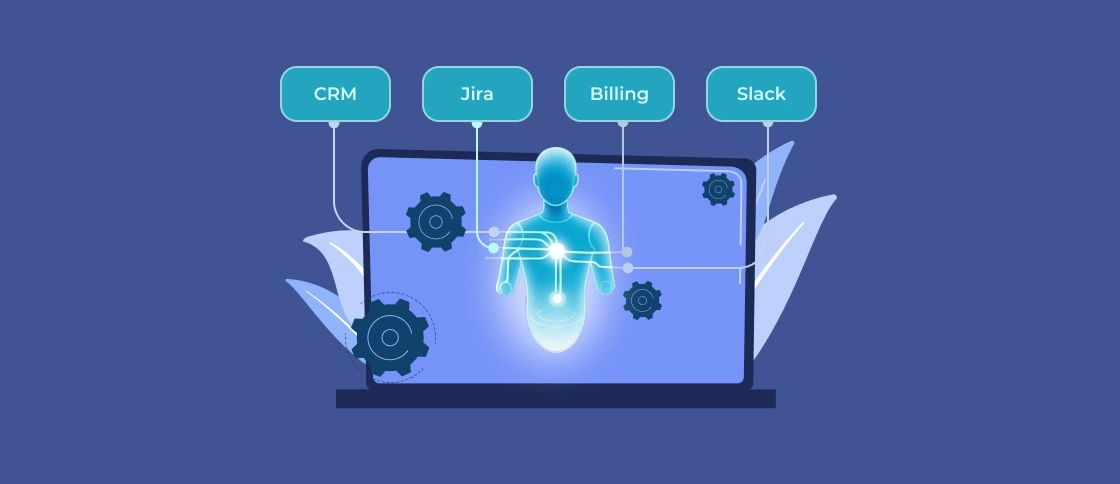
When an employee has to work with a CRM, ERP, email, Slack, and documentation, they have a fragmented context. Information is distributed across multiple sources, and employees spend increasing amounts of time searching for and verifying it.
For example, a support engineer might open a ticket, then search for a client in the CRM, check the billing status, view past incidents, read the Slack thread, check the deployment status, and only then make a decision about routing or escalation.
Technically, this isn’t the most complex task. But the coordination overhead around it becomes enormous.
At some point, employees begin to act as “human middleware” between systems. This is where AI agents can create the greatest value. They will not replace humans. They will become a coordination layer connecting systems, teams, and operational processes.
Workflows with manual follow-up and approvals
AI agents work especially well in processes where execution depends on constant follow-up.
A Customer Success Manager awaits approval from Finance. The Delivery Team can’t begin onboarding without documentation from the client. The Support Team makes repeated escalations because an issue is stuck between departments. The Operations Manager manually verifies who is currently responsible for the next stage.
These processes, combined, gradually create hidden operational drag:
- increase cycle time
- lead to SLA delays
- create excessive context switching
- make execution dependent on specific employees
- increase the number of missed handoffs
The more systems involved in a workflow, the faster the coordination overhead grows.
AI agents help reduce this burden. They gather context, initiate follow-up, remind about approvals, and maintain visibility across teams.
Why Ownership Is More Important Than It Seems
Another important criterion for a good AI-agent workflow is having a clear owner. Without operational ownership, AI workflow automation quickly degrades. No one handles the quality of the workflow, no one updates the orchestration logic and measures the impact of automation on business metrics. As a result, the AI initiative turns into a technical experiment without a clear operational outcome.
This is why the best enterprise AI workflows usually already include:
- process owner
- clear bottlenecks
- measurable delays
- visible business impact
This is especially important for early PoCs. When a company sees that automation has reduced handling time, trust in AI initiatives within the organization grows faster.
Where AI Agents Become Overkill
Many companies are currently trying to add AI to virtually every operational workflow. But not every process benefits from agent-based orchestration. If the workflow is completely deterministic, AI usually becomes unnecessary complexity.
For example, data synchronization, scheduled exports, invoice processing are reliably addressed through classic automation. If you know the process logic in advance and it rarely changes, a reasoning layer is simply unnecessary.
AI agents begin to add value in a different category of workflows. For example, where execution depends on changing context and coordination between many people.
It’s also important to consider the scope of the process. If the workflow occurs seldom and requires almost no manual coordination effort, AI orchestration may be more expensive than the problem itself.
How to Choose Your First AI PoC Agent
The most common mistake in early AI initiatives is choosing a first use case that’s too big or too “smart.” The first proof-of-concept shouldn’t be the most innovative, but rather the most operationally understandable. The best processes are:
- the problem is already clearly visible to the business
- employees regularly encounter manual coordination
- workflow creates measurable delays
- there is a clear owner
- improvement can be quickly measured
These workflows bring the fastest ROI and become the safest entry point for AI adoption.
Good first PoCs are often associated with support triage, onboarding orchestration, internal approvals, or incident coordination.
At the same time, it’s best to keep the first workflow limited in scope. If automation immediately affects critical end-to-end processes, companies often encounter issues even before achieving measurable results. It’s much more effective to start with a single operational bottleneck, where improvements can be quickly seen in real metrics:
- reduced handling time
- faster approvals
- lower SLA violations
- fewer escalations
- reduced manual follow-up
- less context switching
Why AI Agents are Primarily a Coordination Technology
Today, AI agents are often perceived as an attempt to replace employees. But in most internal workflows, their primary role is far more practical. They reduce friction between systems, teams, and business processes.
Because the main problem is that context exists across systems. Also, ownership is blurred between departments and coordination remains entirely manual.
This is why the best AI-agent workflows rarely look “futuristic.” They are typically repetitive operational processes with extensive follow-up, routing, approvals, fragmented context, and hidden delays. But it is precisely these processes that often deliver the fastest and most measurable operational ROI from AI automation.
How Softacom Can Help
At Softacom, we help companies identify operational workflows where AI agents create measurable business value.
Our team supports organizations with AI Integration services, specifically:
- AI-agent workflow assessment and PoC planning
- cross-system AI orchestration
- AI integration with CRM, ERP, ticketing, and internal platforms
- onboarding and support workflow automation
- AI-powered operational coordination solutions
- old system modernization required for AI adoption
We help companies launch practical AI initiatives with faster ROI and lower implementation risk.